The personal computing landscape is undergoing a silent but radical structural shift. For years, human-computer interaction relied almost entirely on glowing glass screens, from desktop monitors and laptops to pocket-sized smartphones. However, as professional workflows demand greater mobility and immediate, hands-free data access, the industry is moving toward ambient computing interfaces. This transition relies heavily on the development of ultra-low-latency wearable audio networks and highly precise micro-sensor arrays that sit directly on the user’s body.
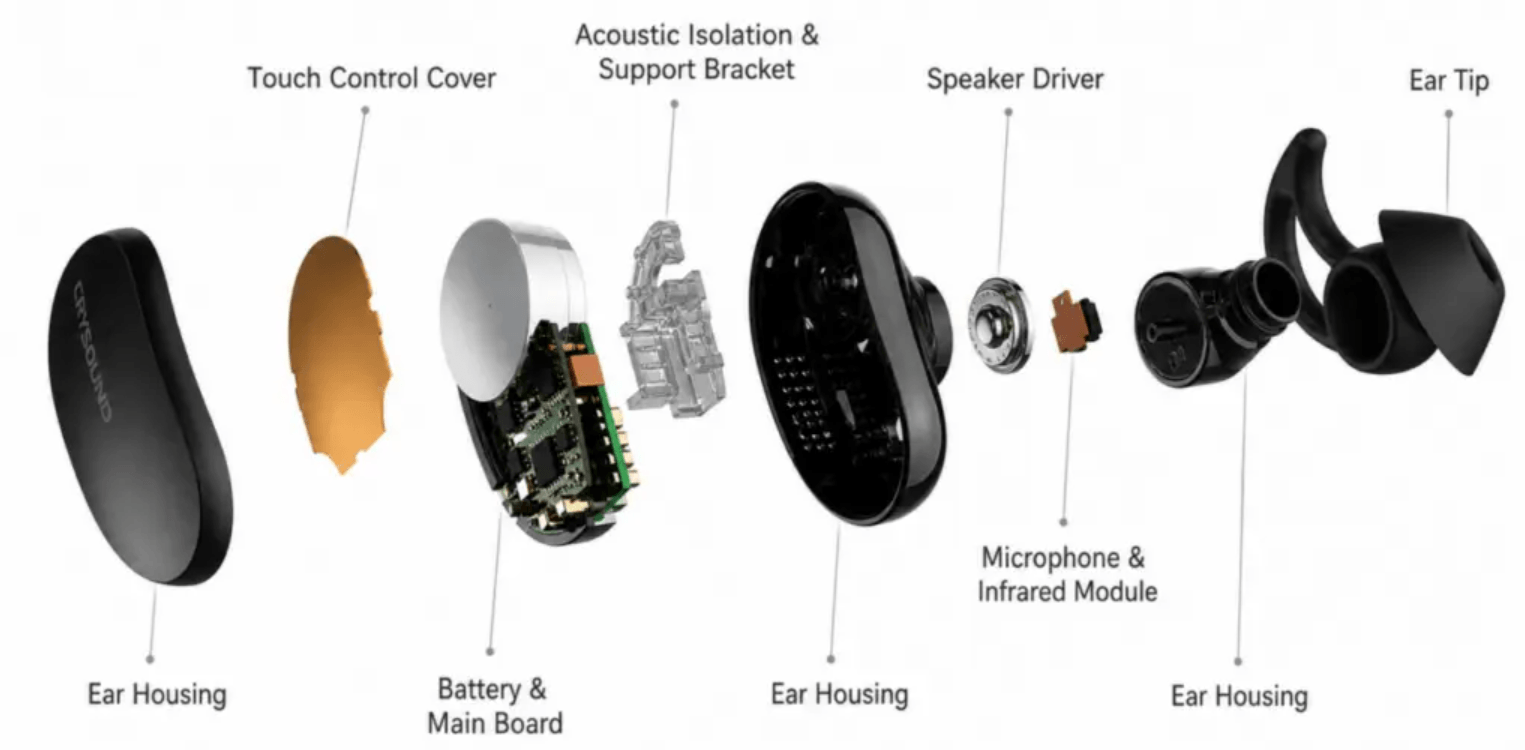
At the center of this movement is a specialized, screen-free network composed of sub-centimeter hardware components. By pairing an advanced smart ring worn on the finger with high-fidelity wireless earbuds nestled inside the ear canal, engineers are creating a unified biometric and command system. This integrated network allows professionals to manage data streams, interact with localized artificial intelligence engines, and track vital signs in real time without ever needing to look at a traditional screen or interrupt their physical workflow.
Architectural Challenges of Extreme Miniaturization
Building hardware that fits seamlessly into the natural curves of the human body requires breaking past traditional circuit design limits. In standard mobile devices, developers have relatively generous spaces to arrange microchips, power lines, and internal communication antennas. When engineering a sub-centimeter wearable, every fraction of a millimeter must be optimized.
To achieve this level of compact design, manufacturers rely on highly advanced System-in-Package (SiP) and flexible printed circuit board (PCB) architectures. In a premium smart ring, for instance, a multi-layered flexible circuit board is carefully wrapped inside a protective housing made of titanium or technical ceramics.
This tiny ring assembly manages an array of complex components:
- A high-efficiency microcontroller unit (MCU) configured with low-power sleep cycles.
- An ultra-precise inertial measurement unit (IMU) tasked with capturing subtle gesture paths in three-dimensional space.
- A set of multi-wavelength optical bio-sensors placed firmly against the skin of the finger to capture continuous heart-rate variations.
Managing these components in such a tight space creates major battery limitations. Because these tiny devices can only accommodate micro-capacity lithium-polymer cells, the internal software must be incredibly efficient, utilizing intelligent power gating to shut down inactive circuits when no movement or data requests are detected.
The Physics of Ultra-Low-Latency Wireless Protocols
For a screen-free audio and sensor network to function effectively in professional settings, communication delays must be practically nonexistent. If a user performs a touch gesture or issues a verbal command, any noticeable delay before receiving audio confirmation can disrupt their natural workflow and break user immersion. Reducing this communication lag requires a complete overhaul of traditional short-range wireless protocols.
Standard wireless audio options often introduce communication delays ranging from 100 to 300 milliseconds. While perfectly acceptable for listening to music or watching video clips, this latency becomes highly disruptive during real-time workflows, such as live multi-lingual translation, interactive industrial manufacturing, or high-stakes field communication.
To overcome this bottleneck, next-generation wireless earbuds implement advanced audio streaming protocols based on the latest low-energy standards. These updated profiles utilize optimized audio compression codecs that dramatically compress digital audio packets without sacrificing acoustic clarity.
By switching from large, variable data packets to short, fixed-interval transmissions, these advanced low-energy systems compress the entire wireless transmission loop down to a sub-30 millisecond window. This immediate response speed ensures that when a user interacts with a connected smart ring to navigate an audio menu or confirm an inventory log, the audio feedback arrives instantly in their ear, creating a seamless and highly responsive user experience.
Multimodal Inputs: Combining Motion Gestures and Acoustic Sensing
Eliminating traditional touchscreens requires creating alternative ways for users to interact with their devices naturally and reliably. Modern ambient computing platforms achieve this by combining motion gestures with advanced acoustic sensing.
The high-precision inertial tracking chips built into a premium smart ring continuously scan for specific movement patterns, such as a subtle finger flick, a gentle hand wave, or a precise double-tap gesture. Localized machine-learning algorithms process these raw movement points right on the device chip, translating intentional movements into system commands while filtering out accidental day-to-day hand actions.
This precise movement tracking is designed to work in tandem with the advanced voice-capture hardware embedded inside modern wireless earbuds. Standard exterior microphones often pick up loud background chatter or harsh wind interference, which can easily confuse voice-recognition software.
To bypass this issue, premium earpieces integrate internal bone-conduction sensors alongside their standard microphone arrays. These specialized sensors detect the physical vibrations traveling through the user’s jawbone when they speak. By combining these direct structural vibrations with external vocal recordings, the system can cleanly isolate the user’s voice from intense environmental noise, allowing for flawless voice commands even on busy factory floors or crowded city streets.
Read also: 8 Telehealth Weight Loss Services Worth Your Time Right Now
Biometric Data Syncing: Creating a Complete Picture of User Wellness
Beyond serving as a screen-free control interface, combining multiple micro-wearables unlocks powerful new ways to monitor personal health and environmental awareness. Because the finger and the ear canal are packed with dense networks of surface capillaries, they represent two of the most accurate spots on the human body for gathering clean biometric signals.
A continuous data link between these two points allows for a comprehensive look at physiological health:
- Capillary Pulse Volume: The optical sensors inside a smart ring track peripheral blood flow changes, offering deep insights into blood oxygen saturation and circulatory efficiency.
- Core Temperature and Arterial Flow: At the same time, the specialized internal sensors of advanced wireless earbuds capture continuous inner-ear temperature readings and precise arterial pulse waves near the head.
Cross-referencing these data streams allows localized health software to build a highly accurate map of the user’s physical condition. If the system catches a sudden rise in inner-ear temperature paired with an elevated resting pulse rate and dropping blood oxygen levels, it can instantly send an audio warning to the user, advising them to take a break or step out of a harsh workspace before heat exhaustion or severe fatigue sets in.
The Evolution of Screen-Free Professional Ecosystems
As the underlying technology powering micro-sensors and low-latency audio continues to mature, the need for bulky handheld monitors and physical control terminals will steadily decrease. The ongoing development of sub-centimeter components shows that the future of enterprise productivity lies in lightweight, interconnected hardware that blends naturally into daily life.
By shifting heavy data processing tasks directly to highly efficient, on-device silicon nodes, these compact systems deliver incredible performance without compromising user privacy or consuming excessive amounts of power. Moving forward, the harmonious integration of advanced control surfaces like a smart ring with high-performance audio tools like professional wireless earbuds will continue to reshape the workplace. This combination provides modern professionals with an uncompromised, screen-free gateway to digital information, enabling peak productivity wherever duty calls.